June 20, 2026 · HVA Resilience Committee
The Lockwood Drive Knee Wall — A Near-Term Fix for Our Flooded Edge
Lockwood Drive floods even on sunny days. The City's near-term "knee wall" — a sub-2-foot seawall with check valves and a gate — is designed to keep the road dry and work hand in hand with the larger Battery Extension.
A shorter, faster wall meant to keep Lockwood dry until the Battery Extension arrives
Lockwood Drive floods even on dry, sunny days. The highest “king” tides regularly push water over the road near Broad Street, closing lanes and spilling traffic into the residential streets to the north — including ours here in Harleston Village. To address this in the near term, the City of Charleston is advancing a small seawall along Lockwood known as the “knee wall.”
What it is
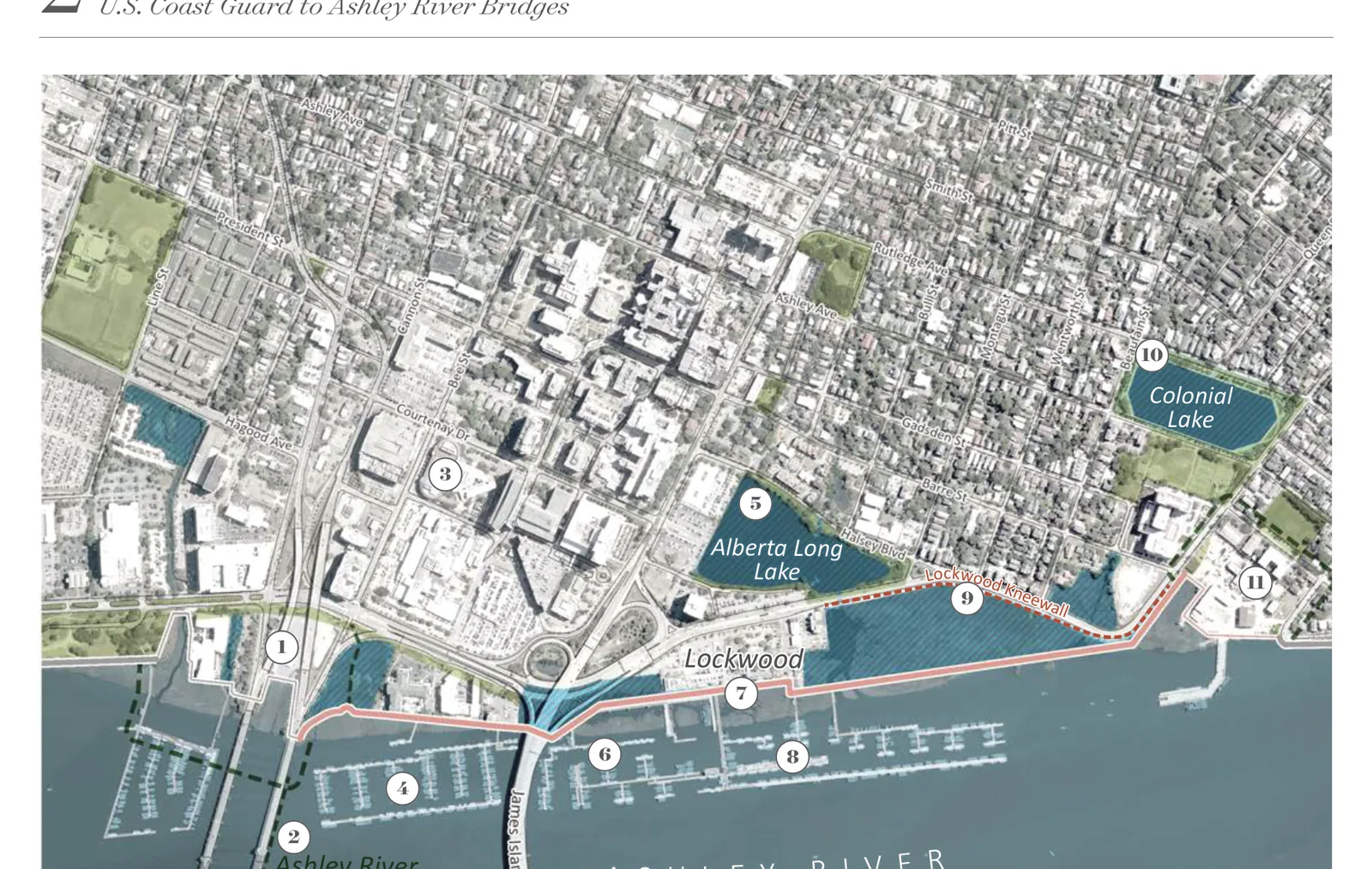
The knee wall is a low barrier — less than two feet tall — running along Lockwood Drive from the Charleston City Marina to Barre Street. It would include check valves and a movable gate to control water moving in and out during king tides and heavy rain. The City describes it as a short-term measure designed to hold back sunny-day and king-tide flooding for roughly the next 20 years.
Beyond keeping the road passable, the wall would also stabilize the Ashley Riverwalk — the popular sidewalk between Lockwood and the marsh — where repeated flooding has been scouring out the ground underneath.
How it works with the Battery Extension
The knee wall and the much larger Battery Extension are designed to work hand in hand. The knee wall is the near-term bridge — buildable soon and at a fraction of the cost — while the Battery Extension is the long-term perimeter protection that won’t be constructed along Lockwood until the late 2020s and beyond.
They also connect functionally. Ensuring downtown can still drain during a storm requires “polders” — areas inside the wall that hold stormwater until tides drop (Colonial Lake and Alberta Sottile Long Lake already do this today). If the Battery Extension is ultimately built out along the line where the marsh meets the Ashley River, the knee wall could help form a new polder in what is now marsh. The intent, in the City’s words, is for the two projects to “meet in the middle” and connect.
Storm surge, tides, or rain?
The knee wall is one of three different answers to three different flooding problems:
| Flooding | Cause | Primary defense |
|---|---|---|
| Storm surge | Hurricanes | Battery Extension |
| Tidal / sunny-day | King tides, no storm | Knee wall now, Battery Extension later |
| Rainfall | Rain can’t drain out at high tide | Drainage & pumps + the storage basin the walls create — knee wall now, Battery Extension later |
See how all three work together →
Status & cost
Preliminary design was completed around 2020, then shelved during the pandemic while the City focused on the federal perimeter-protection partnership with the Army Corps of Engineers. In October 2024, City Council approved $264,247 to finish the design, with engineering firm JMT engaged to complete it. As of early 2025, officials reported the project remained on schedule.
City Councilman Mike Seekings, who represents the area and has championed the project, has estimated construction costs in the seven figures (single-digit millions) — a small fraction of the City’s nine-figure local share of the Battery Extension.
Sources: Live 5 News (Oct. 2024); The Post and Courier, “Rising Waters” and Editorial Board (Oct.–Nov. 2024); City of Charleston Committee on Public Works and Utilities minutes (Jan. 2025).